

“Stop calling your parents’ place ‘home.’ THIS is your real home now.”
“You’re not Verma anymore. You’re Sharma now. Get used to it.”
“You’re still using your maiden name? It’s been over a year since the wedding. What are you trying to prove?”
“Your father’s name served its purpose. Time to let it go, dear.”
Sounds familiar? If you’re a married woman in India, you’ve likely heard some version of these statements delivered with a smirk, disguised as concern, wrapped in mock humor, or thrown at you as casual commentary on your life choices.
The underlying assumption is always the same, always unquestioned: marriage automatically erases your maiden name and replaces it with your husband’s surname.
Your identity? Negotiable.
Your choice? Irrelevant.
Your attachment to the name you’ve carried for twenty, twenty-five, thirty years? Sentimental nonsense that needs to be overcome.
But here’s what they conveniently forget to mention: It’s completely optional!
The Legal Truth:
In India, a common social script suggests that a woman’s identity undergoes a metamorphosis the moment she marries. She enters as Ms. Verma and is expected to emerge as Mrs. Sharma. But is this transformation a legal mandate or a social habit? The short answer is: It is a habit.
Let’s be absolutely clear about the law in India: There is no legal requirement for women to change their surname after marriage.
Your surname does not automatically change when you sign a marriage certificate. It remains exactly what it was unless you actively choose to change it. The belief that women must change their names is purely a social custom, not a legal obligation. It’s a tradition that has been followed for generations, but tradition does not equal law.
The Emotional Toll Nobody Talks About
Here’s what people don’t understand, or perhaps choose not to see: these comments aren’t funny. They’re not harmless. They hurt.
For many women, marriage is already an emotionally overwhelming transition. You’re leaving the home you grew up in, the room where you studied for exams and cried over heartbreaks, the kitchen where your mother taught you to cook, the living room where your family gathered every evening. You’re leaving your parents, who suddenly feel older and more fragile than you ever noticed before. You’re leaving the familiar comfort of your childhood routines, your neighborhood, sometimes even your city.
You’re already negotiating a new household with different rules, different rhythms, different expectations. You’re already trying to build a relationship with your in-laws, adjusting to being a wife, managing the complicated emotions of independence and loss, excitement and grief, all tangled together.
Your emotions are already overflowing. You’re already holding back tears when your mother hugs you goodbye after a visit. You’re already feeling the ache of not being there for the daily rhythms you grew up with, the evening conversations, the festivals, the ordinary moments that made that place home. You’re already struggling with the strange sensation of being a guest in the place you grew up, while simultaneously being expected to treat a new house as “yours.”
And into this raw, vulnerable emotional space, people throw their casual cruelty.
“This is your real home now. Stop being so attached to your parents’ place.”
Do they not see how much that hurts? How it dismisses decades of love, memories, and belonging? How it suggests that loving your parents and your childhood home is somehow incompatible with building a new life?
Do they not understand that you’ve carried that name your entire conscious life? That your school certificates bear it, your college degree displays it, your first job offer letter addressed it, your friendships were built under it, your achievements were earned with it? That it isn’t just a surname. It’s connected to your sense of self, your professional identity, your accomplishments, your history?
When they laugh at a woman for wanting to keep her name, they’re not making a harmless joke. They’re invalidating her identity. They’re telling her that everything she was before marriage doesn’t matter anymore. They’re suggesting that her feelings, her attachments, her sense of self are all obstacles to be overcome rather than valid parts of who she is.
This isn’t funny. This is cruel.
This is the name crisis that millions of Indian women navigate in silence, their hurt dismissed as oversensitivity, their choices mocked as rebellion, their identities treated as negotiable commodities in the transaction of marriage.
The Indian Legal Shield: “Your Name is Your Property”
There is no specific “Act” in India that says “A woman must keep her name,” but the right is protected by the highest law of the land: The Constitution of India!
If anyone questions a woman’s right to her maiden name, these three Articles are her defense:
- Article 21 (Right to Life & Personal Liberty): The Supreme Court has interpreted “Life” to mean more than just breathing; it includes the Right to Live with Dignity. Forcing a woman to abandon the name she was born with; her history, her degrees, her identity; is a violation of her dignity and personal liberty.
- Article 19(1)(a) (Freedom of Speech & Expression): “Expression” includes the expression of one’s own personality. Carrying one’s maiden name is a fundamental form of self-expression that the State cannot suppress.
- Article 14 (Right to Equality): Since a man is not required to change his name upon marriage, forcing a woman to do so would be discriminatory and unconstitutional.
The Supreme Court Precedent
The most significant recent judgment on this matter is Jigya Yadav v. CBSE (2021). In this case, the Supreme Court of India observed that:
“An individual’s name is an intrinsic element of their identity… The right to control one’s identity is a fundamental right.”
This judgment cements the fact that your name is yours to control, not your husband’s and not the State’s.
The “Trap” of Reverting
There is a critical legal reason to keep your name rather than change it and try to switch back later. In 2024, the Department of Publication (Government of India) issued a controversial notification requiring married women to obtain a “No Objection Certificate” (NOC) from their husband if they wish to revert to their maiden surname after having changed it.
The Implication: If you change your name to your husband’s, you might legally need his permission to get your own name back later. This notification is currently being challenged in the Delhi High Court, but it highlights why retaining your name from the start is the safest legal option.
Global Perspectives: Where Changing Your Name is Illegal
While India leaves it to “choice,” other nations view the erasure of a woman’s name as a violation of her rights.
| Country | The Law | The Logic |
| Quebec (Canada) | Illegal. Since 1981, a provincial law forbids women from taking their husband’s surname. | To ensure total gender equality, a woman remains legally known by her birth name for life. |
| Greece | Mandatory Retention. A 1983 law requires women to keep their birth names for legal purposes. | Part of a feminist legal overhaul to dismantle patriarchal family structures. |
| France | “Usage Name” only. Your legal name (nom de famille) is always your birth name. You may “use” a spouse’s name socially, but official records remain in your birth name. | The State recognizes citizens by their birth identity, which is immutable. |
| South Korea | Custom. Women keep their surnames. | Names signify bloodline/clan (Bon-gwan). Marriage does not change your bloodline, so it cannot change your name. |
The History: Why Do We Do It?
If the law doesn’t demand it, why is the pressure so high?
To understand why women are expected to change their names after marriage, we must look back at a troubling history of women’s subjugation. The practice is an import of English Common Law, specifically the doctrine of Coverture, which held that upon marriage, the legal existence of the woman (feme sole or single woman) was entirely suspended and merged into that of her husband.
The tradition crystallized in the 15th century when marriage began to be conceived as a legal and spiritual union where two people became “one.” This was based on the Biblical notion that “husband and wife are one person in law,” and that one person was always the husband. She took his name because, in the eyes of the law, she literally became him. She could not own property, sign contracts, or be sued.
Marriage as Property Transfer
The roots go even deeper. Marriage as an institution emerged from practices designed to entrench women’s subordination. In patriarchal societies, women were treated as property, transferred from father to husband.
When a young woman moved from her father’s home to her husband’s home, she was effectively changing ownership. Taking the husband’s name served as evidence of this transfer of possession, much like branding livestock or signing a deed.
This wasn’t metaphorical. Women were literally considered property under the law, with few or no independent rights. This wasn’t about love or partnership. It was about power, property, and patriarchy.
How It Spread Globally:
The practice of women changing surnames wasn’t originally universal, even in Europe. It became widespread through British colonization starting in the 16th century. As the British Empire expanded across North America, Asia, Africa, and Australia, it exported its legal systems, including coverture and the practice of surname change.
India’s adoption of this practice is a direct result of British colonial rule and the imposition of English common law principles on diverse Indian communities that had their own varied naming traditions.
While the laws of Coverture have been abolished (women can now own property and vote), the social custom of the name change lingered as a vestige of that erased identity.
Colonial Hangover
The assumption that women must change their names after marriage is a colonial hangover, a remnant of laws that treated women as property. It’s time to recognize this practice for what it is: optional, not obligatory.
If you want to take your husband’s surname, that’s entirely your choice, and it’s valid. But if you want to keep your maiden name, that choice is equally valid and legally protected.
No one should pressure, mock, or question a woman’s decision about her own name. Not family members, not in-laws, not colleagues, not bureaucrats, and not society at large.
Your name is your identity. Your choice about what to call yourself is fundamental to your autonomy as a person. Whether you’re Verma, Sharma, or anything else, it’s your decision and yours alone.
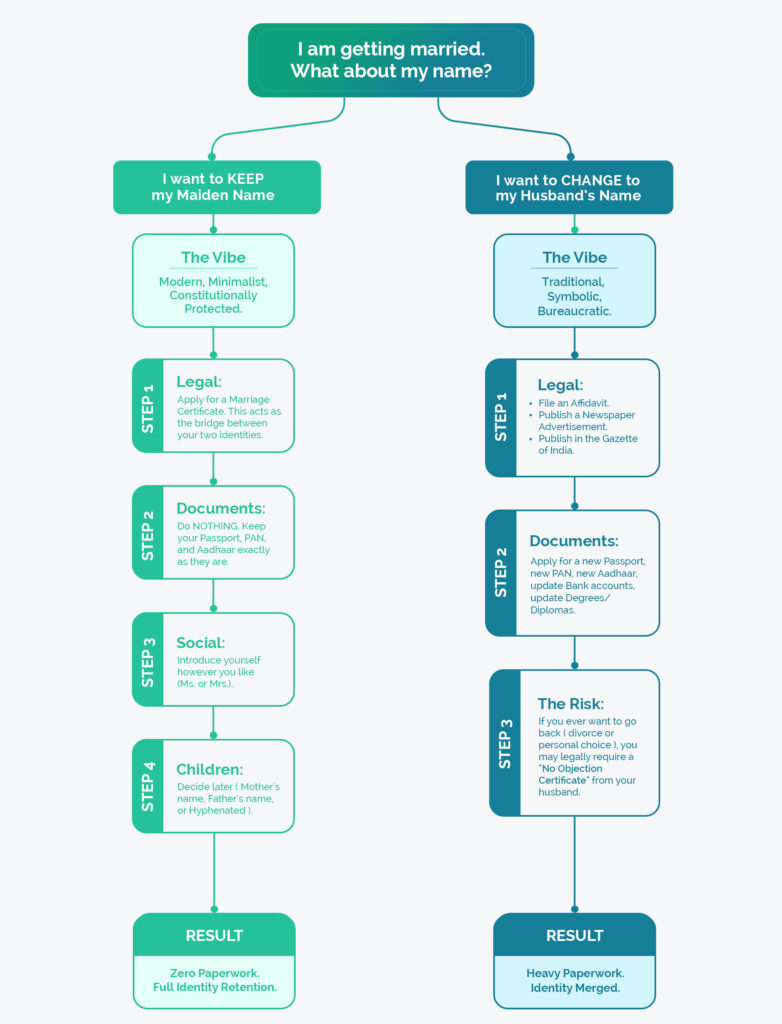
The Decision Flowchart
Practical Guide: How to Stay “You” on Paper
If a woman decides to keep her maiden name, here is the operational reality:
- The Marriage Certificate is Key: This is the only document that links the two identities. It proves that “Ms. A” is the wife of “Mr. B.”
- Passport & Visas: You do not need to change your name on your passport.
Update: The Ministry of External Affairs now allows you to add your spouse’s name as a detail (on the last page) without a Marriage Certificate, using “Annexure J” (a joint affidavit). Your surname on the front page remains unchanged.
- Bank Accounts: Joint accounts can be opened easily by submitting the Marriage Certificate or Annexure J.
- Children: In India, a child can legally carry the father’s surname, the mother’s surname, or a hyphenated combination of both.
The Reckoning
We are living through a quiet cultural shift. For decades, the question was, “Will her in-laws allow her to keep her name?” Today, the question is becoming, “Can she afford to lose it?”
The reckoning is here, and it is driven not just by feminism, but by pragmatism.
- The Professional Cost: In the age of LinkedIn and digital footprints, a woman’s name is her brand. Dr. Riya Singh who becomes Dr. Riya Kapoor essentially deletes her past publications, citations, and reputation. She becomes a “fresher” in the search results.
- The Bureaucratic Nightmare: We live in an era of hyper-documentation (KYC, Aadhaar linking). A name change is no longer a simple romantic gesture; it is a procedural avalanche. One mismatch in spelling can freeze bank accounts or stall visa applications for years.
- The Autonomy Check: The realization that the “tradition” is actually a remnant of Coverture; the legal erasure of women; is making many rethink the romance of it. Women are realizing that a partnership of equals does not require the silent deletion of one partner’s history.
Indian law is crystal clear: Marriage is a partnership, not an acquisition.
There is no section in the Hindu Marriage Act, Special Marriage Act, or the Indian Constitution that mandates a woman to take her husband’s surname. The Supreme Court (Article 21) protects your name as your fundamental right to life and dignity. The Marriage Certificate is the only document you need to prove your relationship; your identity remains your own.
Your name is the headline of your life’s story. It carries the weight of your childhood, the grit of your education, and the legacy of your ancestors.
Marriage is a union of two souls, not the clerical error of erasing one.
Keep your name. Not because it is ‘modern,’ but because it is yours. You are not property to be relabeled; you are a person to be recognised. Let the Marriage Certificate bridge your lives, but let your name define your own.

No responses yet