


In the last article, ( The Autopsy of a Culture ) we dissected the rot. I told you about the daughters we failed, the wounds that never close, and the culture that wraps girls in pink ribbons while binding them in iron chains. I laid bare the personal cost of being born female in India, the violations we survive, the erasure we endure, the guilt you’ll carry when it’s too late to act.
The autopsy continues. This time, we’re examining the organs: the numbers, the laws, the courts. Every part of this diseased system laid bare. Every failure documented.
Here it is. Every statistic the government buries in reports nobody reads. Every law that exists on paper but dies in practice. Every failure of a system that was never designed to save us.
Fair Warning:
These aren’t just numbers. They’re daughters. Sisters. Mothers. Women whose names you’ll never know because they became data points instead of people!
The Numbers That Scream And the Silence That Follows
Let me paint you a picture of what “normal” looks like in India.
Every 20 minutes, a woman is raped in this country.
Not in some war zone. Not in some dystopian nightmare. Right here. Right now. In the India we call “the world’s largest democracy.”
By the time you finish reading this article, another woman will have been violated.
In 2021, the National Crime Records Bureau (NCRB) recorded approximately 31,700 rape cases. That’s roughly 86 cases every single day. Not 86 allegations. Not 86 “he said, she said” situations. 86 registered cases where a woman or child walked into a police station; if she was lucky enough to make it that far; and reported being raped.
By 2023, that number had climbed past 32,000.
But here’s the part that should make your skin crawl: 89% of rapists are known to the victim.
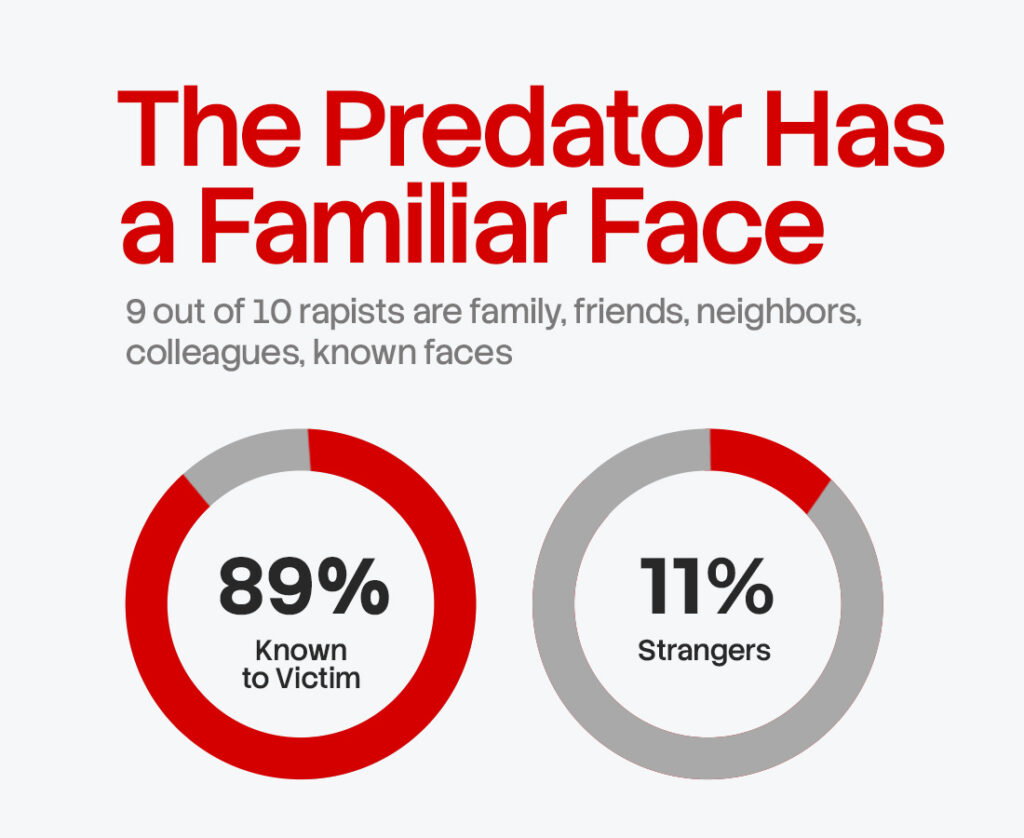
Read that again. Nine out of ten times, the rapist is not a stranger in a dark alley. He’s someone she knows. Someone she trusts. Someone who sits at her dinner table. Your neighbor. Your uncle. Your colleague. Your friend. Your husband. The “good family man” everyone respects. The boy next door. The teacher. The priest. The coach.
The monster doesn’t have horns. He has a familiar face.
Hold on! One in every ten rape victims in India is a minor. A child. Someone who should be learning multiplication tables and playing with friends, not learning the word “rape” through lived experience.
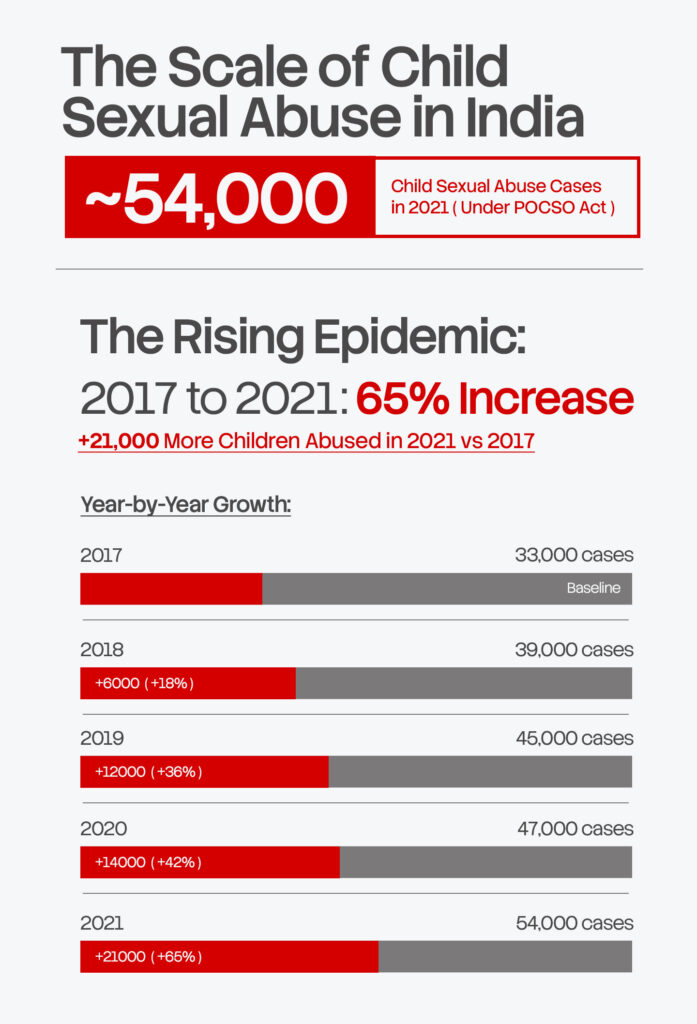
Between 2016 and 2021, cases registered under the Protection of Children from Sexual Offences (POCSO) Act: India’s law designed specifically to protect children from sexual abuse; increased by approximately 30%.
In 2021 alone, nearly 54,000 cases of child sexual abuse were reported. That’s a 65% increase from 2017.
In four years, child sexual abuse cases went up by nearly two-thirds. While we were busy with our hashtags and our candlelight vigils and our outraged tweets, thousands more children were being violated.
And here’s the most devastating truth of all:
these numbers only represent reported cases.
According to the National Family Health Survey, 86% of victims never seek help.
77% never disclose the assault to anyone: not police, not family, not friends.
They carry it alone, buried deep, festering like an infection with no cure.
So when you see “approximately 31,700 rape cases,” understand this: that number is a fraction of the reality. Multiply it by seven, maybe ten. That’s closer to the truth.
Welcome to the India we don’t discuss at family dinners. Welcome to the India where your daughter, your sister, your wife has probably been harassed, groped, or worse, and never told you because she knew you wouldn’t believe her. Or worse, that you’d blame her.
The Geography of Horror
Where Predators Thrive
Violence against women isn’t spread equally across India. Some states have turned it into an epidemic.
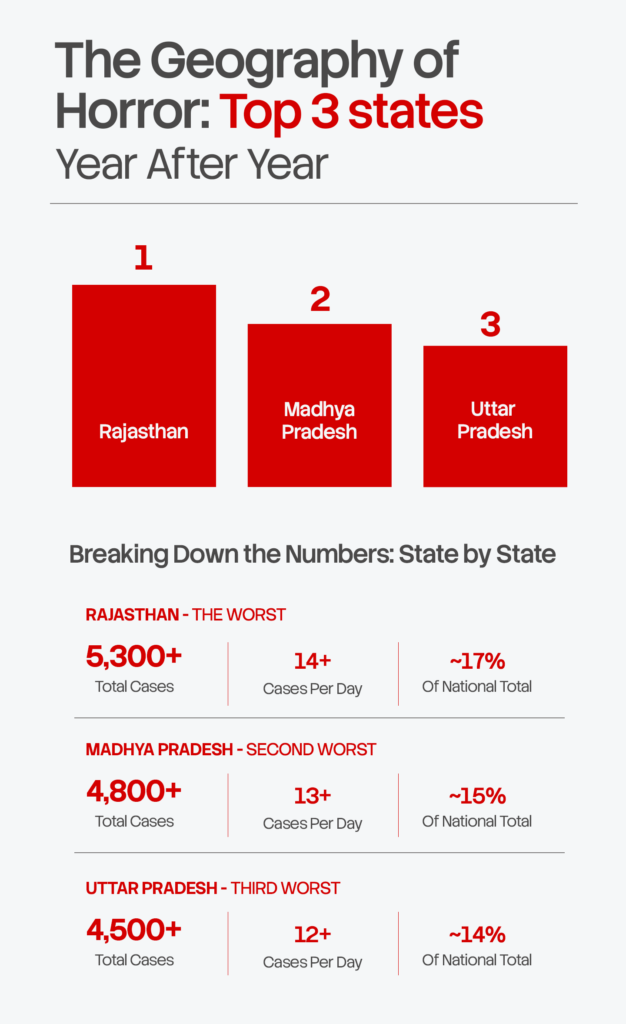
Rajasthan, Madhya Pradesh, and Uttar Pradesh consistently report the highest number of rape cases year after year. These aren’t anomalies. These are patterns. Cultural cesspools where women’s bodies are treated as territory to be conquered.
Delhi, our “progressive” capital, our “cosmopolitan hub,” recorded over 1,200 rape cases in recent data. The highest among all metropolitan cities. The city that prides itself on being modern, educated, forward-thinking is also the city where a woman is least safe.
Remember the Nirbhaya case? Remember the outrage, the protests, the promises of change? Delhi is still leading the rape statistics over a decade later.
But here’s what you need to understand: low numbers in some states don’t mean safety. They mean silence.
They mean police stations that refuse to register FIRs. They mean families that would rather hush up a rape than face “social shame.” They mean victims who know that reporting will destroy their lives more than staying quiet.
So when you see a state with “low rape statistics,” don’t be fooled. Ask the real questions: How many FIRs were refused at police stations? How many families pressured victims into silence to protect their “honor”? How many women knew that reporting would brand them “characterless” while their rapist remained the “good family man”? Low statistics don’t mean safety. They mean a system so dangerous, so humiliating, so futile that women choose to carry trauma alone rather than face what reporting will do to them.
The Conviction Crisis:
Where Justice Goes to Die
Now let’s talk about what happens after a woman musters the courage to report.
You’d think with over 31,000 rape cases reported every year, we’d see mass convictions, right? Rapists locked up, justice served, predators removed from society?
Wrong!
The conviction rate for rape cases in India hovers between 27-28% according to NCRB data from 2018-2022.
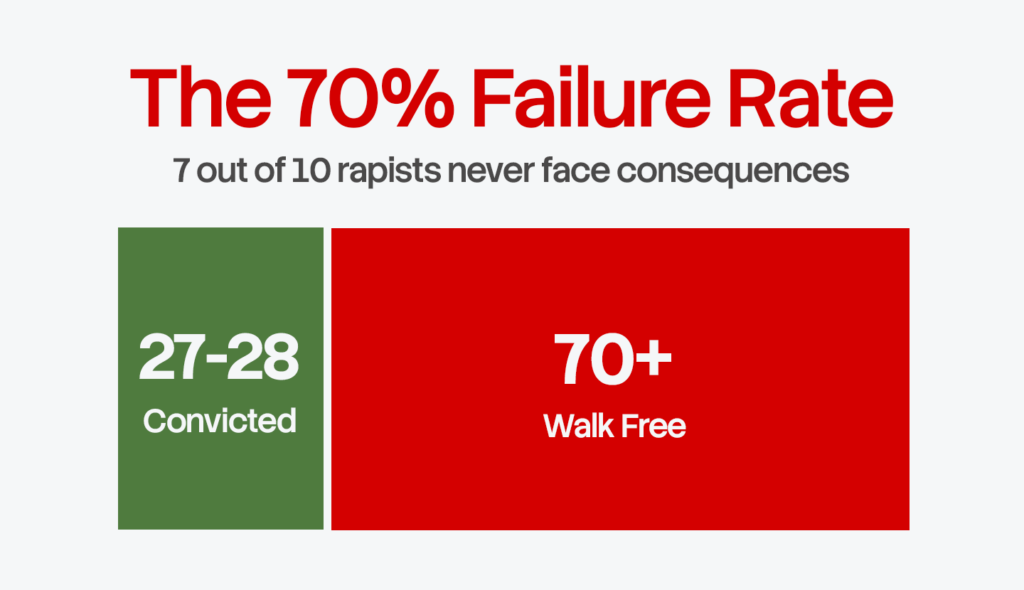
Let me translate that for you: Out of every 100 reported rapes, only 27-28 result in conviction. The other 70+ rapists walk free.
Think about what that means. A woman gathers the courage to report, already a monumental act given the stigma, the shame, the victim-blaming. She endures invasive medical examinations. She sits through police interrogations where officers ask her what she was wearing, why she was out at night, whether she “led him on.” She faces her rapist in court. She relives her trauma in front of strangers who look at her with suspicion instead of compassion.
And there’s a 70% chance the man who raped her will never face consequences.
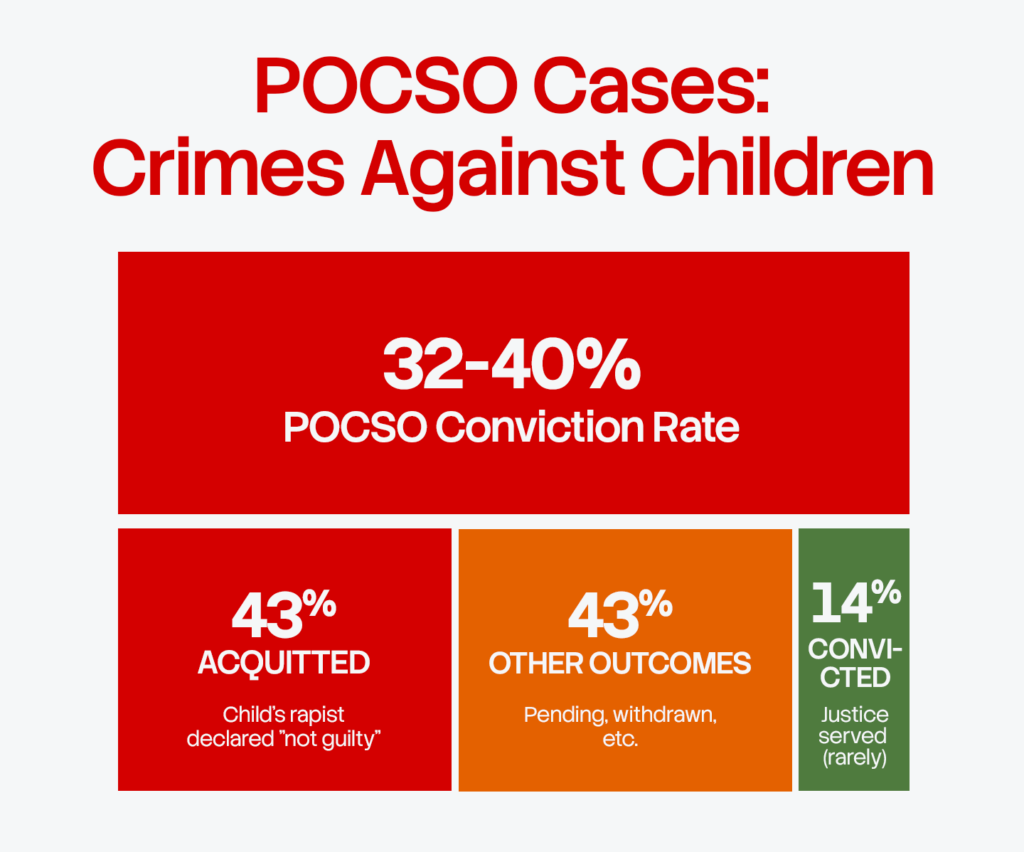
For POCSO cases; crimes against children; the conviction rate is barely better, fluctuating between 32-40%. We’re talking about children here. Children who were raped. And still, more than half the time, the rapist walks free.
According to NCRB 2022 data, the overall conviction rate across all crimes in India is approximately 2.5%. Let me spell that out: Out of nearly 198,000 cases that went to trial, only around 5,000 resulted in convictions.
Approximately 43% of POCSO trials end in acquittals. Nearly half. These are children whose rapists are declared “not guilty” despite going through the entire legal process.
And only around 14% of trials end in convictions.
This isn’t a justice system. This is a game rigged in favor of predators.
When a rapist knows he has a 70% chance of walking free, what’s stopping him from doing it again? When the system itself tells him “you’ll probably get away with it,” why would he stop?
And let’s be brutally honest: when a grown man forces himself on a child, what more evidence do we need? The act itself is the confession. The violation of a child’s body is not something that requires “benefit of doubt” or “innocent until proven guilty.” A child cannot consent. A child cannot seduce. A child cannot be blamed. Yet somehow, we’ve built a system that requires the child to prove she was raped, rather than demanding the man prove he didn’t commit an act that should be self-evident.
The Pendency Nightmare:
Justice Delayed Is Justice Murdered
But wait. It gets worse.
Even in the rare cases where rapists are actually charged and trials begin, those cases get stuck in a legal black hole that can last years, sometimes decades.
The pendency rate for POCSO cases in Indian courts is over 94%. For rape cases, it’s similarly high.
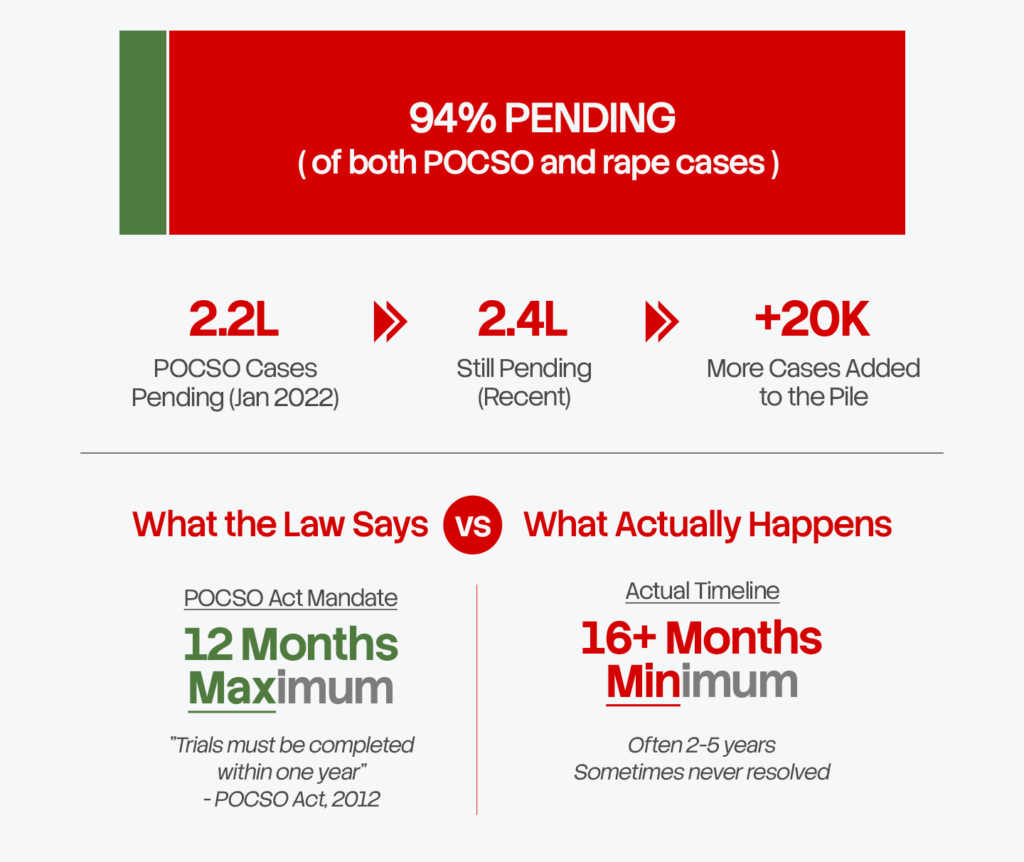
Let me break that down: 94 out of every 100 cases are still pending in court. They haven’t been resolved. They’re just sitting there. Waiting. Rotting.
As of January 2022, over 2.2 lakh POCSO cases were pending in courts across India. Recent data shows approximately 2.4 lakh cases still pending.
In West Bengal alone, nearly 49,000 rape and POCSO cases are pending. That’s one state. One.
The law mandates that POCSO trials must be completed within one year. It’s written right there in the Act. One year. That’s supposed to be the maximum.
In reality? Trials drag on for 16+ months at minimum. Often years. The Kathua case; where an eight-year-old girl was brutally gang-raped and murdered in a temple; took over a year just to reach a verdict. And that was a case with massive media attention, public outrage, and national pressure.
Imagine the cases that don’t make headlines. The ones buried in court backlogs. The ones where nobody’s watching.
What happens to the victim during those years?
She waits. She lives in limbo. Every court date is a fresh wound. Every adjournment feels like the system telling her, “Your trauma doesn’t matter enough to hurry.”
She watches her rapist walk around freely, going to work, living his life, maybe even marrying, having children. While she’s stuck in this nightmare, reliving the assault every time she has to testify.
And as months turn into years, evidence disappears. Witnesses “forget” what they saw, or get paid to forget. Families give up. The accused use the delay to their advantage, intimidating victims, bribing officials, lawyering up with expensive legal teams that know how to exploit every loophole.
By the time the trial finally concludes; if it ever does; the victim is exhausted. Broken. Sometimes she doesn’t even show up anymore. The system has beaten her down so thoroughly that she just wants it to end, even if that means her rapist goes free.
This is how rapists win. Not by proving innocence, but by outlasting their victims.
The Laws That Exist But Protect No One
“But we have laws!” people protest. “We have strong legislation! We strengthened everything after Nirbhaya!”
Do we?
Let me list the laws that supposedly protect women and children in India:
1. The Criminal Law Amendment Act, 2013 (Post-Nirbhaya)
Introduced after the brutal 2012 Delhi gang rape that shook the nation. The amendments strengthened rape laws, introduced the death penalty for repeat offenders and cases resulting in death, made voyeurism and stalking punishable offenses, and expanded the definition of sexual assault.
On paper, it was revolutionary. In practice? See the conviction rates above.
2. Protection of Children from Sexual Offences (POCSO) Act, 2012
This law was specifically designed to protect children from sexual abuse. It mandates:
- Child-friendly court procedures
- Fast-track trials (completed within one year)
- Stringent punishments including life imprisonment
- Special courts dedicated to trying these cases
- Protection of the child’s identity
Sounds good, right? Except 94.4% of POCSO cases are still pending. Fast-track trials? Where?
3. Bharatiya Nyaya Sanhita, 2023
This recently replaced the Indian Penal Code, claiming to “modernize” criminal law with stronger provisions against crimes targeting women.
Too new to judge its effectiveness, but given how previous laws have been implemented or rather, not implemented forgive me for not holding my breath.
4. Fast Track Special Courts (FTSCs)
The government proudly announced the creation of over 1,000 FTSCs across India, with nearly 390 courts exclusively for POCSO cases.
And yet, somehow, approximately 2.4 lakh cases are still pending.
5. Zero FIR Provision
This provision allows a victim to file a rape complaint at any police station, regardless of jurisdiction. The police are then supposed to transfer it to the appropriate station.
In theory, this removes a major barrier for victims. In practice? Police still routinely refuse to register rape cases, citing “jurisdiction issues” or telling victims to “think about their family’s reputation”.
6. Two-Finger Test Ban
The Supreme Court banned the degrading “two-finger test”; a virginity test that had no scientific basis and served only to humiliate rape victims during medical examinations.
Banned in 2013. And yet, reports still surface of doctors performing it.
7. Free Medical Treatment
Rape victims are entitled to free medical care at government hospitals.
Great. Except many victims report being turned away, being made to wait hours, being treated with contempt by medical staff who view them as “characterless women” rather than trauma survivors needing care.
So yes, we have laws. We have courts. We have provisions.
Then why are 94% of cases still pending? Why are 70% of rapists walking free? Why is a woman raped every 20 minutes?
Because laws on paper mean absolutely nothing when nobody enforces them. When police don’t register cases. When courts take years to conclude trials. When society blames victims. When families pressure survivors to stay quiet.
The laws exist to make us feel better. To let us say, “See? We did something.” But they were never meant to actually work.
The Hidden Epidemic: What the Numbers Will Never Show
Now let’s talk about the cases that never make it into those 31,677 reported rapes.
The National Family Health Survey found that approximately 86% of sexual violence victims never seek help from any source: not police, not family, not friends, not counselors.
Around 77% never disclose the assault to anyone at all. They carry it alone. Buried. Festering.
Why?
Because 80% of sexual crimes are committed by someone the victim knows, according to NCRB data. A family member. A neighbor. A teacher. A boss. Someone with power over her. Someone she’s supposed to trust.
And she knows what happens if she reports. She knows her family will blame her. She knows society will ostracize her. She knows the police will humiliate her. She knows the trial will destroy whatever’s left of her dignity.
So she stays silent. She survives. She pretends it didn’t happen.
And the rapist? He goes on living his life. He might rape again. Probably will, actually, because he knows he can get away with it.
The Marital Rape Loophole
And here’s the most gut-wrenching part: Marital rape is still not a crime in India.
Let me say that again. A husband can rape his wife, and it is not considered a crime.
Studies show that approximately 20% of men admit to forcing their wives into sex. That’s millions of women being raped in their own homes, by their own husbands, with zero legal recourse.
Why? Because marriage is considered “consent in perpetuity.” Because a wife’s body is viewed as her husband’s property. Because the law literally says that sex between a man and his wife cannot be rape, even if she says no, even if he uses force.
When a woman’s body is not her own within marriage, what hope do we have of protecting her outside it?
What Happens Now?
So here we are:
- Approximately 31,700 reported rapes annually and that’s just a fraction of the reality
- Over 94% of cases pending in courts, some for years
- Around 70% of rapists walking free
- 86% of victims never seeking help
- Children being violated at increasing rates
- Women being murdered for saying no
- A system designed to protect predators
- A society that blames victims
What do we do with this information?
Do we shake our heads, share the article with a sad emoji, and scroll on? Do we wait for the next headline to shock us for five minutes before we forget again?
Or do we actually do something?
Because rage without action is just noise. And we’ve been making noise for too damn long.
If you’ve read this far, you’re complicit in one of two ways: either you’re part of the problem, or you’re ready to be part of the solution.
Here’s how you choose the latter:
1. Report and Support: Be the Person Who Doesn’t Look Away
If you witness harassment, assault, or abuse, report it. Don’t assume someone else will. Be the person who speaks up.
2. Demand Fast-Track Implementation: Courts Exist, Make Them Work
Fast-track courts were created specifically for rape and POCSO cases. They exist. They’re funded. And yet over 94% of cases are still pending. Demand accountability. Push for judicial reforms. Ask why trials take years when the law mandates one year. Make noise. Don’t let them hide behind bureaucratic excuses.
3. Challenge Victim-Blaming Everywhere, Every Time
In your family. In your workplace. In your friend circle. Online. Every time you stay silent when victim-blaming happens, you’re complicit. Every time.
4. Push for Legal Reforms
Criminalize marital rape. Period. No exceptions. Strengthen enforcement of existing laws. Better training for police and judiciary. Harsher penalties for officials who refuse to register FIRs or mishandle cases. These changes won’t happen unless citizens demand them. Loudly. Repeatedly. Relentlessly.
5. Educate Boys! This Is Where It Starts
Teach your sons about consent. Teach them that a woman’s body is not theirs to comment on, touch, or own. Teach them to intervene when they see their friends crossing lines. Teach them that “boys will be boys” is not an excuse. That their mistakes have consequences. That respect is not optional.
Raise boys who flinch at the thought of violating someone’s boundary. Because right now, we’re raising boys who think violation is their birthright.
6. Document and Amplify: Keep the Conversation Alive
Use your platforms: social media, blogs, podcasts, whatever you have to keep these issues in the public eye. Highlight systemic failures. Call out predators and the systems that protect them. Don’t let society’s short attention span erase these truths.
I started this series with a question: Why did it even begin?
Now you know. It began because we let it. Because we built a culture that values a man’s reputation over a woman’s safety. Because we created laws but never enforced them. Because we turned our heads when it was convenient. Because we stayed silent when we should have screamed.
It continues because we are still making the same choices.
But it doesn’t have to.
Every single one of us has the power to disrupt this cycle. To refuse complicity. To demand better. To fight harder.
The data is damning. The system is rigged. The rot runs deep.
But change is possible. If, and only if, we decide it’s non-negotiable.
So the question is no longer “Why did it begin?”
The question is: Will you let it continue?
Because the next headline could be about someone you love. The next statistic could be your daughter, your sister, your wife, your friend. And when that day comes, will you look back at this moment and wish you’d done more? Or will you be able to say, “I fought. I didn’t stay silent. I was part of the solution.”
Choose.

One response
While fast-track courts ensure accountability, the real key to change is shifting how men view and value women, in my opinion.