

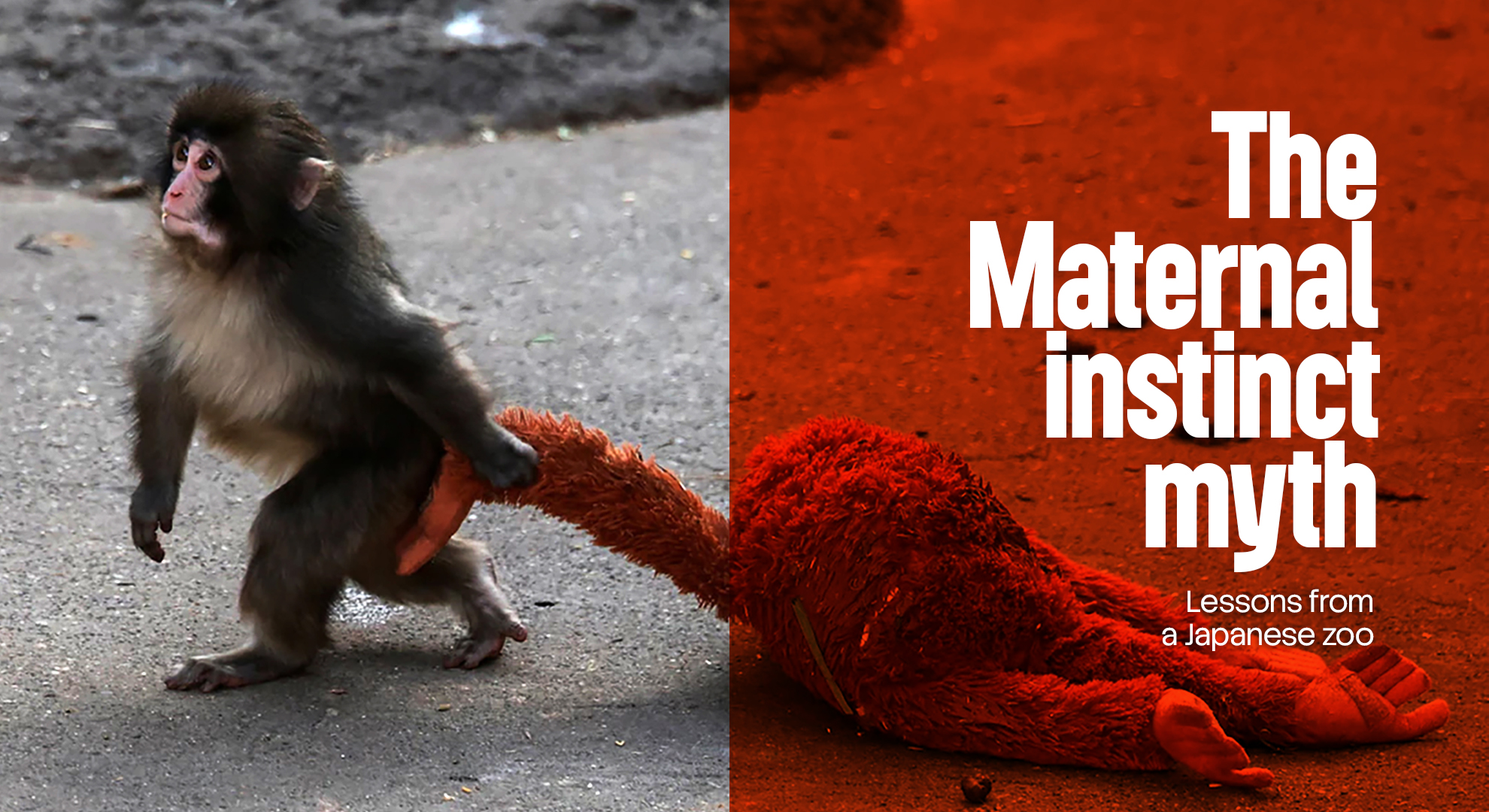
Punch!
A baby macaque who has quietly taken over the world’s attention.
He was abandoned by his mother at birth. And now he spends his days clinging to a plush orangutan. The image is hard to look at. And even harder to look away from. Visitors are flocking to a zoo in Japan just to see him. Social media is flooded with sympathy, debate, and a kind of collective heartache. Somehow, this tiny monkey has reached into something very human in all of us. But underneath all the emotions lies a question that deserves to be asked gently, without judgment.
Why would a mother abandon her own child?
Let’s talk about it.
Before we get into the “why”, let’s talk about what’s happening out there.
Social media has done what social media does. Memes are being made mocking Punch’s mother. AI-generated videos are circulating showing Punch “avenging” her. People have decided she is a villain. They’ve picked a side, made it funny, made it loud, and moved on.
And honestly? It’s hard to watch. Because this is a mother we know almost nothing about. And we’re already putting her on trial.
We’ve done this before. We’ll do it again. Someone shares a story, the internet feels something, and within hours, the feeling turns into a verdict. No context. No science. No curiosity about what actually happened, JUST NOISE.
Punch surely deserves better than that. And so does the truth.
So let’s slow down for a second. Let’s actually understand what’s going on here. The psychology, the biology, the real story behind why a mother, any mother, animal or human, sometimes cannot do what the world expects her to do. Because once you understand it, you won’t want to make the meme anymore.
Why did his mother leave him? And is this the first time a mother in the animal world has abandoned her young? No!
Abandonment in nature is more common than we think. And the reasons behind it are rarely simple. So before we judge, let me tell you a story.
In the 1980s, a famous experiment with a zoo-born female gorilla, proved that motherhood is a learned skill. Having grown up without seeing other gorillas raise infants, she had no “blueprint.” She was terrified of her own baby.
She was raised in captivity her whole life. Never around other gorillas. Never around other mothers. When she gave birth, she had absolutely no idea what to do. She didn’t know how to hold her baby. Didn’t know how to feed it.
Her baby didn’t survive.
When she got pregnant again, the zookeepers refused to let it happen twice. They realised that the problem wasn’t a lack of love, it was a lack of education. They contacted local La Leche League leaders (a volunteer organisation that has been supporting and educating breastfeeding mothers around the world since 1956) and asked them something unusual.
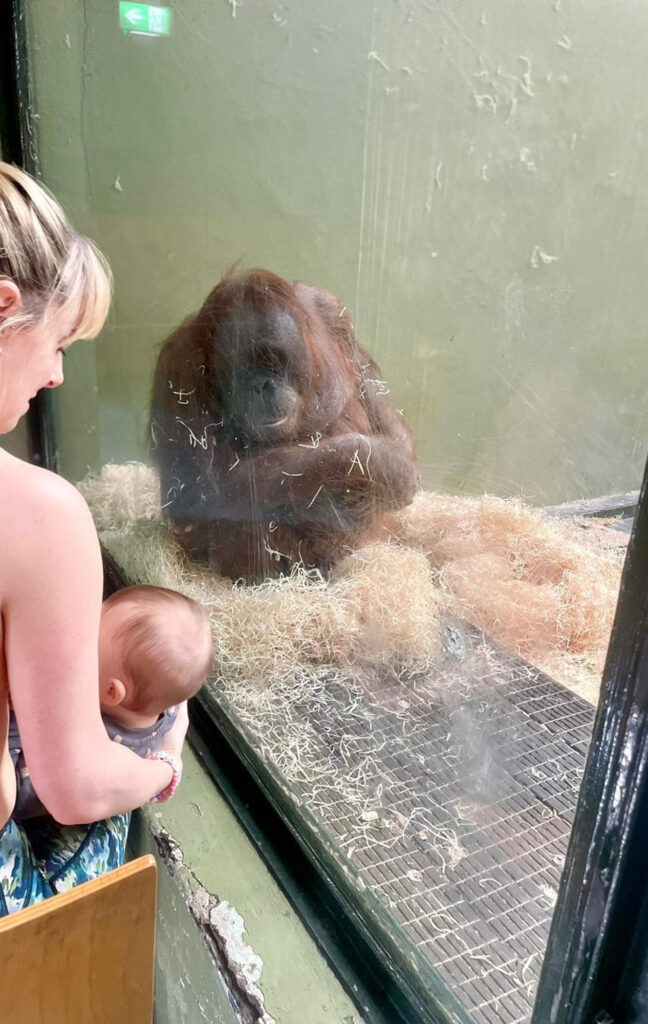
The LLL consultants and human mothers sat outside her enclosure, breastfeeding and cradling their own babies day after day, while the gorilla watched from the other side of the glass. She learned the “how” of motherhood by watching other mothers. That’s it. The knowledge passed right through that glass wall.
When her second baby was born, she put it to her breast.
Punch’s mother was in the same position. Born in a zoo, she lacked the multi-generational “school of mothering” that wild macaques rely on. Add to that the physical trauma of birth and the suffocating July heatwave, and it’s easy to see how her system simply overloaded.
When Punch was born on July 26, 2025, she was a first-time mother facing two massive hurdles:
1. Inexperience: She simply didn’t know what the 500-gram “thing” in her arms was or what it needed.
2. Environmental Stress: It was a record-breaking heatwave in Japan. Between her physical pain and the sweltering heat, her survival instincts likely “short-circuited” her maternal ones.
Punch’s mother wasn’t ‘bad’; she was a product of her environment, a zoo-born girl who had never seen a mother be a mother.
We often treat “maternal instinct” as a biological “light switch”, something that simply flips on the moment a child is born. But as I look at Punch and his plush “Oran-mama,” I’m reminded of my own first days as a mother.
For me, the connection wasn’t a lightning bolt; it was a slow, flickering flame that took time, effort, and a lot of physical strength to keep alive.
Let’s talk about something nobody really wants to say out loud.
Motherhood has been glorified. Beautifully, poetically, endlessly glorified. And a significant part of that glorification resides in a single moment. The moment a mother holds her baby for the first time.
We’ve all heard it. That it’s the most pure, most magical moment of a woman’s life. That something clicks. That the love just arrives, enormous and immediate, like it was always waiting there.
And for some mothers, that’s real. I’m not taking that away from anyone. But that’s not the whole story. And pretending it is has quietly hurt a lot of women.
Here’s what nobody tells you before you become a mother.
Your body just did something enormous. Something that took everything out of you. And the world places a baby in your arms and expects you to glow while you are bleeding. While you cannot stand up on your own feet without holding onto something. While every small movement hurts in ways you didn’t know a body could hurt. While you’re trying to figure out how to sit, how to walk, how to exist in a body that suddenly feels like a stranger.
Nobody talks about that part. The bleeding that goes on for weeks. The soreness that makes something as simple as getting out of bed feel like climbing a mountain. The way your body is simultaneously recovering from the hardest thing it has ever done while also being needed, every hour, by a tiny person who cannot wait.
And in the middle of all of that, you’re supposed to feel the magic!
When they placed my baby in my arms for the first time, I felt confused.
Not overwhelmed with love. Not flooded with magic. Confused. I kept looking at this tiny person, thinking, Is this real? Is this mine? I was waiting for the feeling everyone described. The click. The wave. And it didn’t come. Not in that room. Not in that moment.
I struggled to hold my baby the right way. I struggled to feed her. Things that were supposed to feel natural had to be figured out slowly, sometimes enduring it in silence, sometimes in the middle of the night with a body that was still in pain and a heart that was still finding its way.
The love came. It did. But it didn’t arrive with the baby.
It was built. Feed by feed. Night by night. Mistake by mistake. It grew slowly in the quiet, exhausting, unglamorous work of just showing up every day, even when I had nothing left.
The bond between a mother and her child is real. Deeply, fiercely real. But it isn’t always instant. And for some of us, it takes real time to heal, to adjust, to even fully accept that we are a mother now. That this baby is ours. That this is life now.
That’s not failure.
That’s just the truth that never makes it into the pictures.
Those early days are lonely in a way that’s hard to explain. No one tells you the hardest part isn’t the labour.
The hardest part is everything after. The relentlessness of after. The way it just keeps going every single day, asking everything from you, while you’re still figuring out who you even are now.
I had support. I had people around me. And it was still the most alone I have ever felt.
I think about Punch’s mother sometimes in those moments. I don’t know what she was carrying. I don’t know what was happening in her body, in her mind, in the world around her. I wonder if things would have gone differently for her and for Punch if someone had shown up for her the way those women showed up for the gorilla.
I’m not excusing what happened to Punch. He needed her and she wasn’t there. That’s real.
But I have stopped being quick to judge. Because I know now, in my own body, that becoming a mother doesn’t automatically hand you everything you need to be one. It’s a constant journey of learning, unlearning, and figuring it out as you go. And sometimes, the gap between what you feel and what you’re supposed to feel can be wide and dark and very, very quiet.
Here’s what stays with me about Punch.
He didn’t stop.
Every day he pushes himself back out there. Gets knocked down, gets back up. He is slowly, painfully learning how to belong somewhere that didn’t exactly welcome him.
He still has his plushie. And I should tell you the zookeepers chose that specific stuffed toy on purpose. Its long shaggy fur is close enough to real monkey fur to give Punch something that almost feels like contact. Like being held. But they’ve also said that they hope, over time, the toy matters less. That Punch moves from clinging to the stuffed thing toward real connections with the real troop.
The toy was never the destination. It was just what kept him going long enough to find one.
I think we all have something like that.
The thing we held onto when the real thing wasn’t there. The habit, the comfort, the whatever-gets-you-through. It doesn’t look heroic from the outside. But it is. It really is.
Because the alternative was letting go.
What This Is Actually About
The gorilla story, Punch’s story, my own story, they all come back to the same thing.
The idea that a mother just knows that everything she needs arrives automatically the moment her baby does, is one of the most quietly damaging things we tell each other. It leaves struggling mothers feeling like failures. It makes the loneliness worse, because if this is supposed to come naturally, then something must be wrong with me.
Nothing is wrong with you. Trust me.
The knowledge of how to mother, how to hold, how to feed, how to stay, how to bond moves between people. Between bodies. It’s passed through watching and being watched, through someone sitting beside you, through someone just showing you that it’s okay to not know yet.
The gorilla needed to see it done. Punch needed someone to bottle-feed him through the night. I needed someone to tell me how it’s done and what I was feeling was normal.
Millions of people have watched Punch cling to that stuffed toy and felt something shift in them.
I don’t think it’s just because he’s small and soft and sad and lonely, though he is all of those things.
I think it’s because he is doing, openly, in front of everyone, the thing that most of us have only done in private.
Holding on to what we have. Making do. Getting back out there.
Looking for the soft thing in a world that has been unkind.
And seeing him do it so openly, so honestly, it somehow makes it okay to admit that we’ve done it too. That we’ve all been dragged across the dirt. That we’ve all made our way back to the one soft thing we had and pressed ourselves into it and tried to get through the next hour.
He doesn’t know he’s teaching us anything.
He’s just surviving.
But that’s kind of the whole point!

One response
This is the first time I’ve seen this story shared with kindness instead of anger.
Punch is surviving. His mother was likely overwhelmed. Both things can be true at the same time.
It’s really good to see someone choosing understanding instead of noise. 🤍